

Calibration vs. Validation: What’s the Difference in your Packaging Equipment
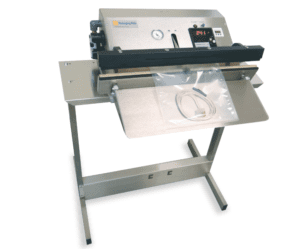
If your business relies on accurate measurements and equipment performance, you may have heard the terms calibration and validation. While they are related, they serve two different purposes—and both can be important for maintaining accuracy, quality, and regulatory compliance. PAC Machinery manufactures packaging and sealing equipment for applications where accurate temperature control, repeatable sealing, calibration, and validation are important.
What Is Calibration?
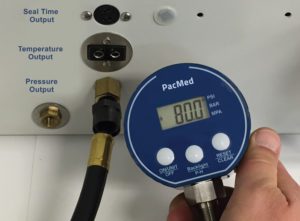
Calibration verifies the accuracy of an individual instrument by comparing its readings to a known reference standard.
For example, a manufacturing thermometer may be compared against a calibrated reference thermometer under controlled conditions. If the instrument is outside its required tolerance, it can be adjusted or otherwise addressed to ensure accurate measurements.
Regular equipment calibration helps reduce measurement errors and provides confidence that your instruments are producing reliable results.
What Is Validation?
Validation is a documented process used to demonstrate that equipment, systems, or processes consistently perform as intended and meet predetermined specifications.
Equipment validation may include Installation Qualification (IQ), Operational Qualification (OQ), and Performance Qualification (PQ). Rather than focusing on one instrument’s accuracy, validation looks at whether the overall system is installed correctly, operates properly, and consistently performs under real-world conditions.
Calibration vs. Validation: The Key Difference
The simplest way to think about it is:
Calibration asks: “Is this instrument measuring accurately?”
Validation asks: “Does this system consistently perform as intended?”
Calibration is generally performed on a recurring schedule, while validation is commonly performed when equipment or systems are initially implemented and when significant changes occur.
Why Both Matter
Calibration and validation work together to support quality, accuracy, operational efficiency, and regulatory compliance. Accurate instruments provide reliable measurements, while validation helps demonstrate that the larger equipment or process consistently delivers the expected results.
If you’re unsure whether your equipment needs calibration, validation, or both, working with a qualified calibration and validation provider can help you determine the appropriate requirements for your application.
FAQ’s
Calibration verifies the accuracy of an individual instrument or measurement device. Validation documents that equipment, systems, or processes consistently perform as intended and meet defined requirements.
Packaging equipment may require calibration when it relies on measurable parameters such as temperature, pressure, time, or other process variables that need to remain within defined tolerances.
Yes. Packaging equipment can be validated to demonstrate that it is installed correctly, operates according to specifications, and consistently produces the intended results. Depending on the application, this may involve IQ, OQ, and PQ.
IQ (Installation Qualification) verifies that equipment is installed correctly. OQ (Operational Qualification) verifies that it operates as intended. PQ (Performance Qualification) demonstrates that it consistently performs under actual or intended operating conditions.
Validation requirements depend on the application, industry, quality system, and regulatory requirements. It is particularly important in critical or regulated applications where consistent equipment performance and documented results are required.
Depending on the equipment and application, sealing equipment, temperature controls, sensors, controllers, and other measurement or process-control components may be calibrated or incorporated into a validated packaging process.
They help provide confidence that equipment is operating within defined requirements and that critical process parameters are measured and controlled consistently. This can support product quality, process repeatability, and compliance requirements.
PAC Machinery has decades of experience developing packaging and sealing equipment for critical applications where measurement, process control, calibration, and validation are important considerations. Equipment selection depends on the specific packaging process and application requirements.
PAC Machinery! We are known for our decades of sealing expertise.